GPS Tracking in Agriculture: Precision Farming From the Ground Up
The global precision farming market is projected to grow from USD 11.38 billion in 2025 to USD 21.45 billion by 2032, driven largely by the adoption of GPS-guided machinery and variable-rate application systems. That growth reflects a straightforward reality: satellite positioning has become one of the most practical tools available to growers trying to do more with fewer inputs and tighter margins. At the foundation, the GPS Standard Positioning Service met 100% of its coverage commitment and delivered better than 99% availability in 2024, which means the signal farmers depend on is there when they need it, field after field, season after season.
GPS reached agriculture in the 1990s as a way to steer machinery more precisely. Today it threads through almost every decision on a modern farm: where the tractor drives, how much fertilizer a strip of field receives, where a piece of equipment sits at 2 a.m. on a Sunday. Understanding how each of those uses works, and where the real limitations are, is the starting point for getting value from any GPS investment on a farm.
Most growers face a common set of problems when they try to apply GPS technology. Signals weaken near tree lines and in low-lying terrain. Equipment purchased over a decade can lack the receivers or controllers needed to accept correction signals. Coverage from differential networks varies by region. And the data produced by GPS systems has to integrate with whatever agronomic software the operation already uses. None of those challenges are insurmountable, but each deserves a clear look before committing to hardware and subscriptions.
How GPS Works in a Farm Setting
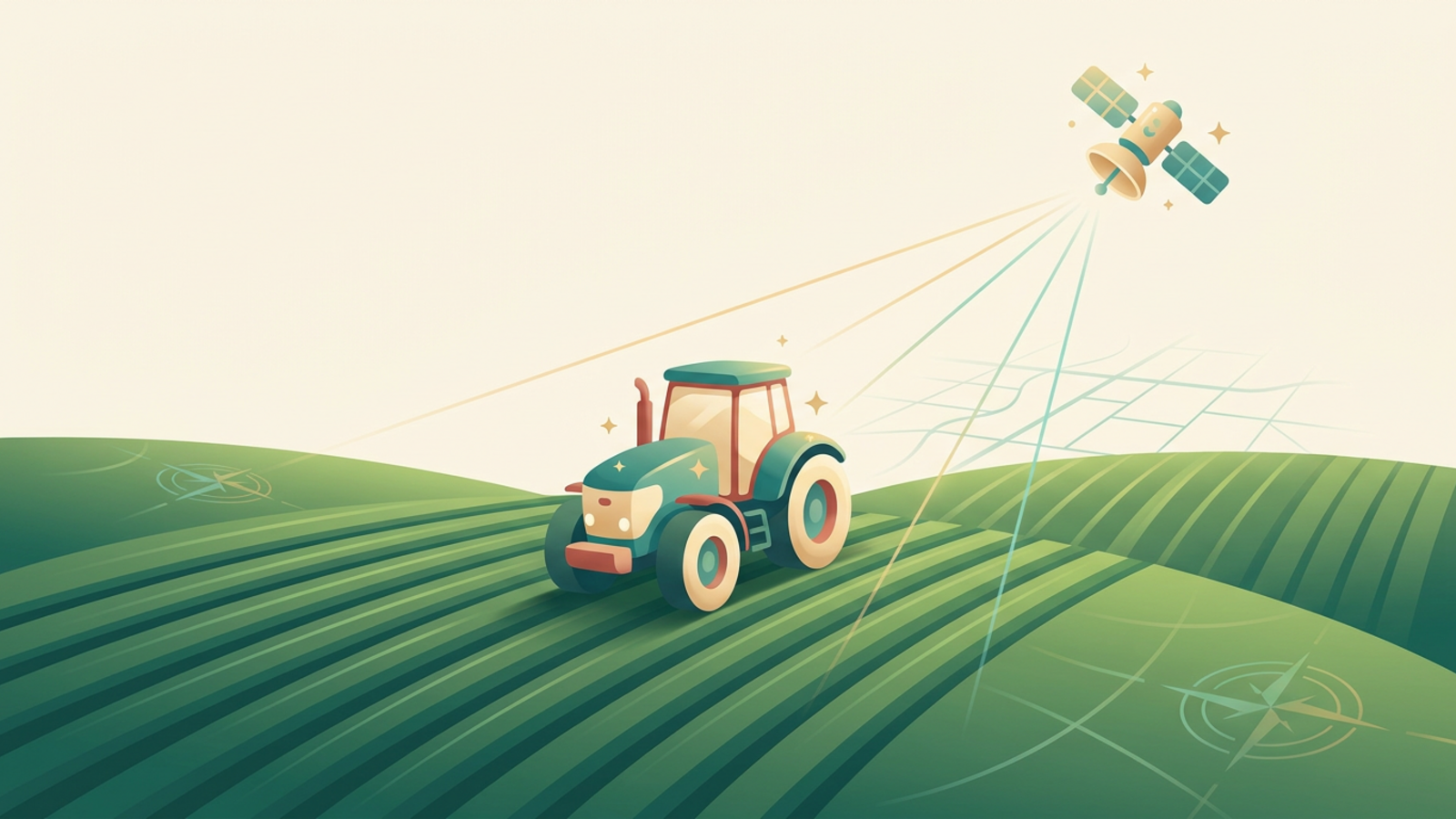
A GPS receiver on a tractor or implement picks up signals from multiple satellites overhead and calculates its position through a process called trilateration. Basic satellite-only positioning places the receiver within a few meters of its actual location. That is accurate enough for field boundary mapping and basic record-keeping, but not accurate enough for row-by-row planting or precise chemical application.
Differential GPS and Real-Time Kinematic (RTK) corrections close that gap. A correction signal from a fixed base station or a subscription network like John Deere’s SF or Trimble’s CenterPoint RX removes most of the atmospheric and satellite-clock errors that inflate the basic position error. RTK systems reach 2 to 5 centimeter accuracy, which is what automated steering systems use to hold a tractor on a line within the width of a finger, pass after pass.
Automated Steering: Where Most Farms Start
Autosteer is typically the first GPS application a farm adopts because the payback is immediate and visible. Manual steering leaves overlaps between passes: two trips over the same strip of ground, which means twice the seed, twice the fuel and twice the wear on the soil structure. Studies from extension programs at multiple land-grant universities put that overlap at 5 to 15% of every field pass under typical manual driving conditions.
An RTK-guided autosteer system holds the tractor to a pre-recorded AB line with centimeter consistency. The operator still manages the implement, monitors crop conditions and watches for obstacles, but the machine follows the line without drift. On a 1,000-acre operation running multiple passes per season, the seed and chemical savings alone commonly recover the cost of the guidance system within two to three seasons.
Autosteer also extends the hours a farm can work. Night passes and early-morning runs that are impractical under manual steering become routine when the machine follows GPS guidance, because the operator no longer needs to see the crop row to hold the line.
Variable-Rate Application and Prescription Maps
GPS ties location to agronomic data, which is what makes variable-rate application (VRA) possible. A prescription map divides a field into management zones based on soil sampling, yield history, satellite imagery or a combination of all three. Each zone carries a target rate for seed, fertilizer, lime or chemical. When the planter or spreader moves through the field, its controller reads the GPS position, looks up the prescription for that zone, and adjusts the application rate automatically.
The practical effect is that high-yield potential areas of a field get the inputs they can use, and areas with poor drainage, shallow soil or compaction get a reduced rate. The farm still applies inputs across the whole field, but the total applied drops because nothing is wasted on zones that cannot respond to it. Nitrogen reduction on variable-rate maps of 10 to 20% compared to flat-rate application is commonly reported in university trials, though actual savings depend heavily on field variability.
Building a prescription map requires a few additional steps: soil sampling on a grid fine enough to capture variability, software to interpolate between sample points, and a controller on the implement that accepts ISO 11783 (ISOBUS) or brand-specific prescription files. The GPS receiver is the common thread that makes the map and the machine talk to each other in real time.
Challenges of GPS Adoption on Working Farms
The technology works, but implementation carries real friction. Signal quality degrades along field boundaries lined with mature trees, and in valleys where satellite geometry is poor, position errors grow even with correction signals. RTK base stations need a clear sky and a reliable radio or cellular link back to the receiver; a failed correction signal mid-pass means the autosteer falls back to open-loop GPS accuracy, which is not tight enough for some applications.
Equipment age is a second barrier. An operation with tractors spanning three decades faces a mix of ISOBUS-compatible machines, older models that accept only proprietary controllers, and implements with no electronic interface at all. Retrofitting older equipment with aftermarket guidance systems is possible, but each machine needs its own receiver, display and actuator, and the costs add up quickly.
Data integration is a third challenge. GPS-capable machines generate large volumes of as-applied and yield data. Moving that data from proprietary brand portals (MyJohnDeere, AFS Connect, Trimble Ag Software) into a single agronomic platform for analysis requires either manual export steps or subscriptions to interoperability services. Farm operations that ignore this step often find they have years of GPS data they cannot use.
GPS for Farm Equipment Security
Agricultural equipment theft is a significant and growing cost for farm operations. GPS asset trackers address it the same way they work in construction or logistics: a cellular-connected device on the machine reports its position at set intervals and triggers an alert if the equipment moves outside a defined boundary.
Hardwired trackers on powered machinery (tractors, combines, sprayers) draw power from the vehicle and report continuously. Battery-powered trackers on trailers, planters, tillage implements and grain carts run on their own supply, with reporting intervals extended to conserve battery life. A geofence around the farmstead or a specific field sends a notification the moment the equipment moves where it should not. Tracking packages aimed at agribusiness operations usually bundle both hardware styles under one dashboard, which spares a grower from running powered and towed machinery on separate systems.
Recovery rates for GPS-tracked stolen equipment are significantly higher than for untracked assets, because law enforcement receives a current location rather than a last-known parking spot. Some farm insurance underwriters offer premium reductions for operations that document GPS tracking on high-value machinery. See the overview of GPS asset tracking for the general principles that apply to any high-value equipment, not just farm machinery.
Yield Mapping and Field Records
A modern combine equipped with a yield monitor and GPS receiver creates a record of how many bushels came off every 10-foot strip of the field during harvest. That data, spatially referenced by GPS coordinates, becomes the most direct measure of where a field produced well and where it did not. Yield maps show drainage problems, soil variability, pest pressure patterns and compaction zones in a way that walking the field simply cannot match.
Year-over-year yield maps reveal patterns that single-season data hides. A zone that consistently underperforms despite good weather and adequate inputs is signaling a management problem that deserves investigation. A zone that consistently outperforms its neighbors is worth understanding so its conditions can be replicated elsewhere. GPS makes it possible to build that multi-year spatial record and act on it.
Connectivity and What Comes Next for Farm GPS
The signal quality and constellation size farms depend on today will improve further as GPS III satellites replace older blocks. GPS III brings a stronger civilian L1C signal and a new L5 signal designed to work better through atmospheric interference, which helps in conditions where older signals degrade. The supplementary GNSS constellations (GLONASS, Galileo, BeiDou) add more satellites visible from any field, improving geometry and reducing the impact of obstructions near tree lines.
Cellular connectivity is extending what GPS-equipped machines can do beyond positioning. Machines connected via 4G or 5G can send as-applied data in real time, receive updated prescriptions mid-field if conditions change, and allow remote diagnostics when a dealer or agronomist needs to review machine performance without a farm visit. The GPS fix remains the foundation; connectivity is what turns that fix into a live data link. For a broader look at how positioning systems work across industries and use cases, the GPS tracking overview covers the full range of applications.
Matching GPS Tools to Your Farm Operation
Not every operation needs RTK accuracy, and not every farm has the agronomic variability to justify prescription mapping. A small diversified farm with short passes and few field hours may get all the benefit it needs from basic GPS field mapping and equipment tracking without investing in autosteer. A large row-crop operation running hundreds of thousands of dollars in seed and chemical costs every season is a strong candidate for every layer of GPS technology available.
Start by calculating the overlap your current driving produces. Multiply that percentage by your annual seed and chemical spend. If the number exceeds the cost of a guidance system in two to three seasons, autosteer earns its place. Then look at field variability: if soil sampling shows meaningful differences across the field, variable-rate prescription maps pay for themselves. GPS for security is worth running on every high-value piece of equipment regardless of operation size, because the tracker cost is a fraction of what a single theft event costs in downtime and replacement. General equipment tracking platforms serve that security layer well even on farms that never adopt guidance or prescription mapping.
Understanding how the satellite signal itself is generated and corrected helps set realistic expectations for each use case. The how GPS works guide covers trilateration, error sources and augmentation systems in plain terms that apply directly to agricultural decisions.
Frequently Asked Questions (FAQs)
How is GPS used in agriculture?+
GPS guides tractors and sprayers along precise field paths, automates steering so operators can focus on equipment, and records exactly where every pass was made. It also powers variable-rate application maps that adjust seed, fertilizer and chemical rates by zone, and tracks equipment location for security and dispatch.
What is precision farming?+
Precision farming is the practice of treating different parts of a field differently based on real data about soil, moisture, yield history and crop health. GPS is the backbone: it ties every sensor reading and every application decision to an exact location, so the right input goes to the right spot at the right rate.
How accurate is GPS for farm equipment?+
Standard GPS puts a receiver within a few meters of its true position. With differential corrections from a base station or a subscription correction service, accuracy tightens to 2 to 10 centimeters. That sub-inch precision is what makes automated steering and pass-to-pass consistency reliable enough to plant row after row without overlap.
Does GPS guidance reduce input costs?+
Yes, measurably. Automated steering eliminates the 5 to 15% overlap that manual driving produces on every pass, which translates directly into fewer seeds, less fertilizer and less chemical used per acre. Variable-rate application, also GPS-driven, cuts inputs further by targeting high-rate zones to areas that need them and reducing rates everywhere else.
Can GPS track farm equipment theft?+
GPS asset trackers are effective against farm equipment theft because they report a machine’s position even when it is moved off the property. Geofences trigger an alert the moment equipment crosses a boundary, and historical location data helps law enforcement recover stolen machinery. Battery-powered trackers on trailers and implements work the same way as hardwired units on powered vehicles.