GPS vs BLE vs RFID: Choosing the Right Tracking Technology

Knowing where your stuff is sounds simple until you try to do it at scale. The global asset tracking market is projected to grow from USD 32.45 billion in 2026 to USD 106.19 billion by 2035, and most of that spending lands on three technologies: GPS, BLE and RFID. They are often pitched as rivals. They are really specialists.
Each one answers a different question. GPS answers “where on Earth is it?” BLE answers “which room or yard is it in?” RFID answers “did it just pass this point?” Picking well saves money: RFID alone accounted for roughly 40% of asset-tracking revenue in 2025, largely because it is so cheap per tag. Choose the wrong tool and you either overpay or lose visibility.
The Real Challenges of Tracking Things That Move
Before comparing specs, name the problems. Outdoor assets travel for miles and need location anywhere. Indoor assets hide behind walls that block satellite signals. High-volume inventory moves too fast and is too cheap to justify a battery-powered device on every item. And every approach has to survive real budgets, real battery limits and real metal-and-concrete environments.
No single technology clears all four hurdles. That is why the comparison below matters: you are not looking for a winner, you are matching a tool to a job.
| Technology | Typical Range | Power Source | Best Use | Rough Cost Per Unit |
|---|---|---|---|---|
| GPS | Global (outdoors) | Battery or vehicle power | Vehicles, equipment, anything that travels | $20 to $300+ plus data plan |
| BLE | 10 to 100 m | Small coin-cell battery | Tools and bins on a fixed site | $5 to $25 per beacon |
| Active RFID | Up to ~100 m | Battery in the tag | Containers and yard assets | $15 to $50 per tag |
| Passive RFID | A few cm to ~12 m | None (reader-powered) | High-volume inventory at checkpoints | $0.05 to $0.50 per tag |
GPS: Global Reach, Built for the Outdoors
GPS, part of the wider GNSS family of satellite systems, fixes a position anywhere with a clear view of the sky. A receiver listens to signals from several satellites and calculates its location through trilateration. That makes GPS the only one of these three that genuinely tells you where an asset is on the map, not just whether it is nearby.
The trade-off is power and signal. A GPS tracker needs a battery or vehicle power, a cellular connection to report back, and an open sky. Indoors, accuracy collapses. For fleets, trailers, heavy equipment and field assets, none of that matters because the work happens outside. Industry glossaries that offer a vendor-neutral definition of GPS tracking land on the same boundary: it is an open-sky technology first.
Strengths: true location anywhere outdoors, mature ecosystem, works across countries.
Limitations: weak indoors, higher per-unit cost, needs power and a data plan.
BLE: Short-Range, Low-Power Proximity
Bluetooth Low Energy trades range for efficiency. A small beacon broadcasts a signal that nearby phones or fixed gateways pick up, so you learn which zone an asset sits in rather than its exact coordinates. Because BLE sips power, a single coin-cell battery can last months or years.
That profile suits indoor and on-site tracking: tools in a workshop, totes in a warehouse, equipment around a depot. BLE will not follow a van across the state, but it shines where GPS goes quiet. Hybrid setups close that gap by relaying tag readings through a cellular hub, an arrangement sold as a combined BLE and GPS tracking network, so a tag that never leaves the yard still reports through a device that does.
Strengths: cheap, long battery life, works indoors, easy to deploy at scale.
Limitations: short range, zone-level not pinpoint, needs readers or phones nearby.
RFID: Cheap, Battery-Free Identification
RFID is the checkpoint specialist. A reader energizes a passive tag as it passes, logging that a specific item moved through a gate, dock or shelf. Passive tags cost pennies and carry no battery, so you can put one on every carton without thinking about it. Active RFID adds a battery for longer range on bigger assets.
RFID does not locate items between checkpoints, and metal or liquids can interfere. But for counting fast-moving inventory and proving chain of custody, nothing else is this affordable per unit.
Strengths: lowest cost per tag, no battery for passive tags, fast bulk reads.
Limitations: proximity only, struggles near metal and liquid, no between-point location.
The Difference Between GPS and RFID, Stated Plainly
These two get compared most often and they have almost nothing in common. A GPS receiver works out where it is by timing signals from satellites, anywhere on Earth, with no infrastructure of yours involved. A passive RFID tag does not know where it is, cannot report anything, and has no battery at all. It becomes visible only when a reader you installed energises it at a doorway or a gate.
So GPS answers where is this thing right now, and RFID answers did this thing pass this point. That is why RFID tags cost cents and GPS trackers cost tens of dollars plus a monthly plan: one is an identity label, the other is a positioning system with a mobile subscription attached.
The practical consequence is that they are rarely alternatives. A warehouse using RFID at its doors still cannot find a pallet that left on the wrong truck, and a fleet using GPS still cannot tell you which of four hundred cartons came off at the third stop. Operations that solve both problems buy both.
Where Ultra Wideband Fits Alongside These Three
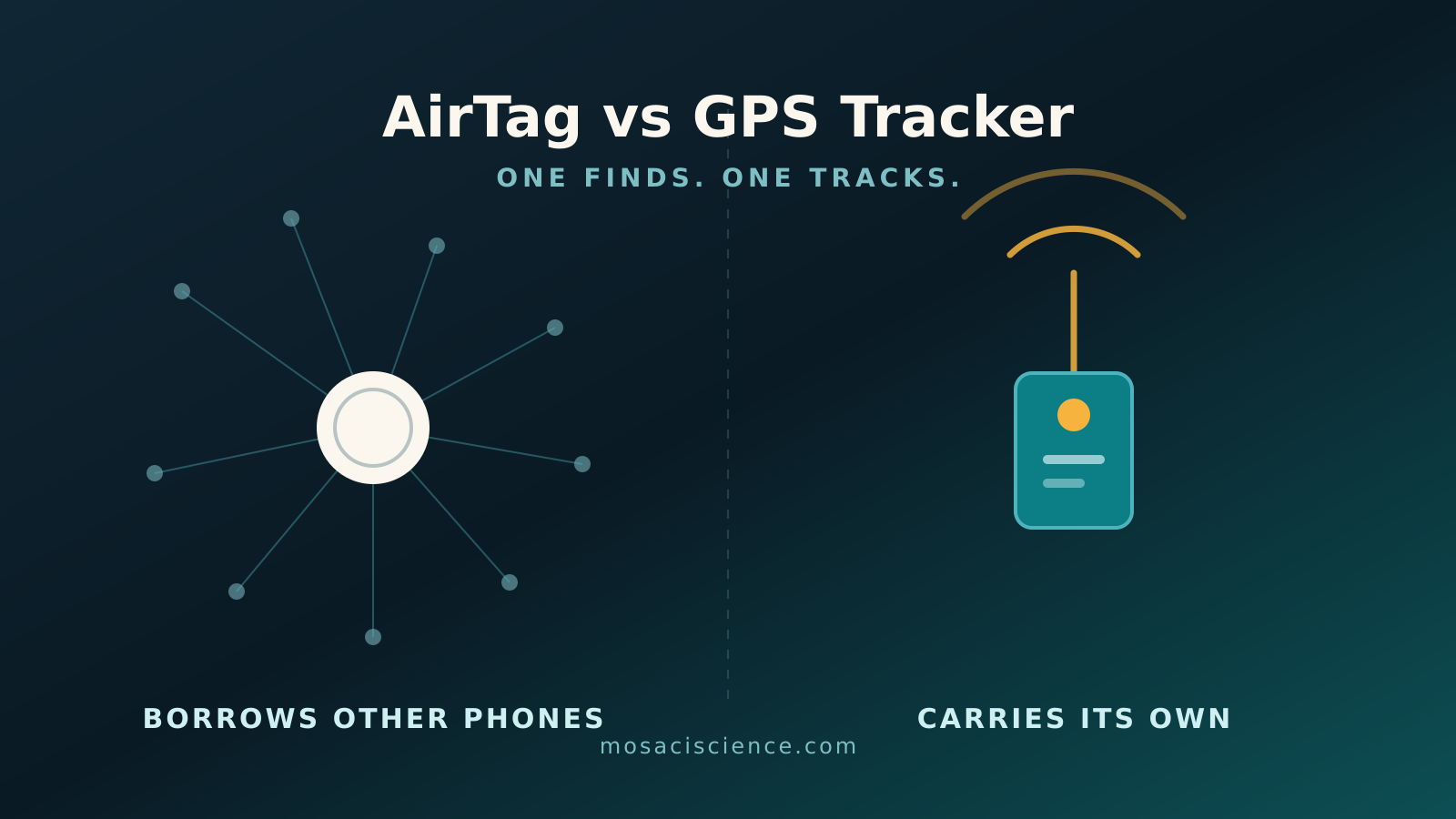
A fourth radio now appears on consumer hardware and is worth placing correctly. Ultra Wideband measures the time a radio pulse takes to travel rather than how strong a signal is, so it reports direction and distance to something a few metres away. Apple uses it for Precision Finding on AirTag alongside Bluetooth and NFC, with no GPS and no cellular radio in the device at all.
That makes UWB a close-range finding aid rather than a tracking technology. It is excellent for the last ten metres of a search, when you already know roughly where the item is, and useless the moment you are not standing near it.
Read against the other three, the hierarchy is simple: RFID tells you something passed a point, UWB tells you where it is in this room, BLE tells you it is near something, and GPS tells you where it is on the planet. Only the last one works with nobody and nothing of yours nearby.
Battery Life Is the Constraint That Actually Separates Them
Published figures make the gap concrete. A passive RFID tag runs forever because it has no battery. A Bluetooth tag runs for years on a coin cell, with manufacturers quoting up to four years from a CR2032 in a 6mm tag. A cellular GPS device is quoted anywhere from a fortnight to a decade, and the whole spread comes from one setting.
That setting is the reporting interval. Every long GPS battery claim in this market is stated at one position fix every twenty-four hours, and the vendors that publish both numbers show what happens otherwise: one states up to 365 days at a daily fix and 48 days if the item moves an hour a day on minute updates, from identical hardware.
So the cost of GPS is not really the device or even the subscription. It is energy, and every design decision in the category follows from it.
How to Match the Technology to Your Tracking Problem
Start with one question: does the asset leave a site you control? If yes, GPS earns its keep, because only satellite positioning follows a vehicle or trailer down the road. If the asset stays inside a building or yard, BLE gives you zone-level visibility for a fraction of the cost and battery drain.
Then ask how many items you are tracking and how cheap they are. Thousands of low-value units passing through doors point straight to passive RFID. Dozens of high-value, mobile assets point to GPS. Most real operations layer all three: GPS on the moving things, BLE inside the four walls, RFID at the gates. Map your assets to those three jobs and the right mix becomes obvious. For a deeper look at where each fits, see our guide to how GPS tracking is used across industries and the breakdown of GPS asset tracking.
Frequently Asked Questions (FAQs)
Can GPS, BLE and RFID work together?+
Yes, and the strongest tracking systems usually combine them. A GPS tracker reports an asset’s location outdoors, BLE tags show where items sit inside a yard or building, and RFID confirms what passed through a gate. Each layer fills a gap the others leave open.
Is BLE better than GPS for indoor tracking?+
For most indoor tracking, yes. GPS signals struggle to reach inside warehouses and basements, while BLE beacons work well at short range and sip power. GPS still wins the moment an asset leaves the building.
How much does RFID cost compared to GPS tracking?+
Passive RFID tags can cost a few cents each, which makes them ideal for high-volume items. GPS trackers run from roughly $20 to several hundred dollars per unit plus a data plan, because each one carries a receiver, battery and cellular radio.
Does RFID need line of sight to work?+
Passive RFID needs a reader within a short range, and performance drops around metal and liquids. It does not need a clear optical line of sight the way a barcode does, but it is a proximity technology, not a locate-anywhere one.
Which technology is best for asset tracking?+
It depends on where the asset goes. Use GPS for vehicles and equipment that travel, BLE for tools and bins that move around a fixed site, and RFID for fast-moving inventory that passes through checkpoints. Many operations run all three.