GPS Jamming and Spoofing: What They Are and How to Stay Protected
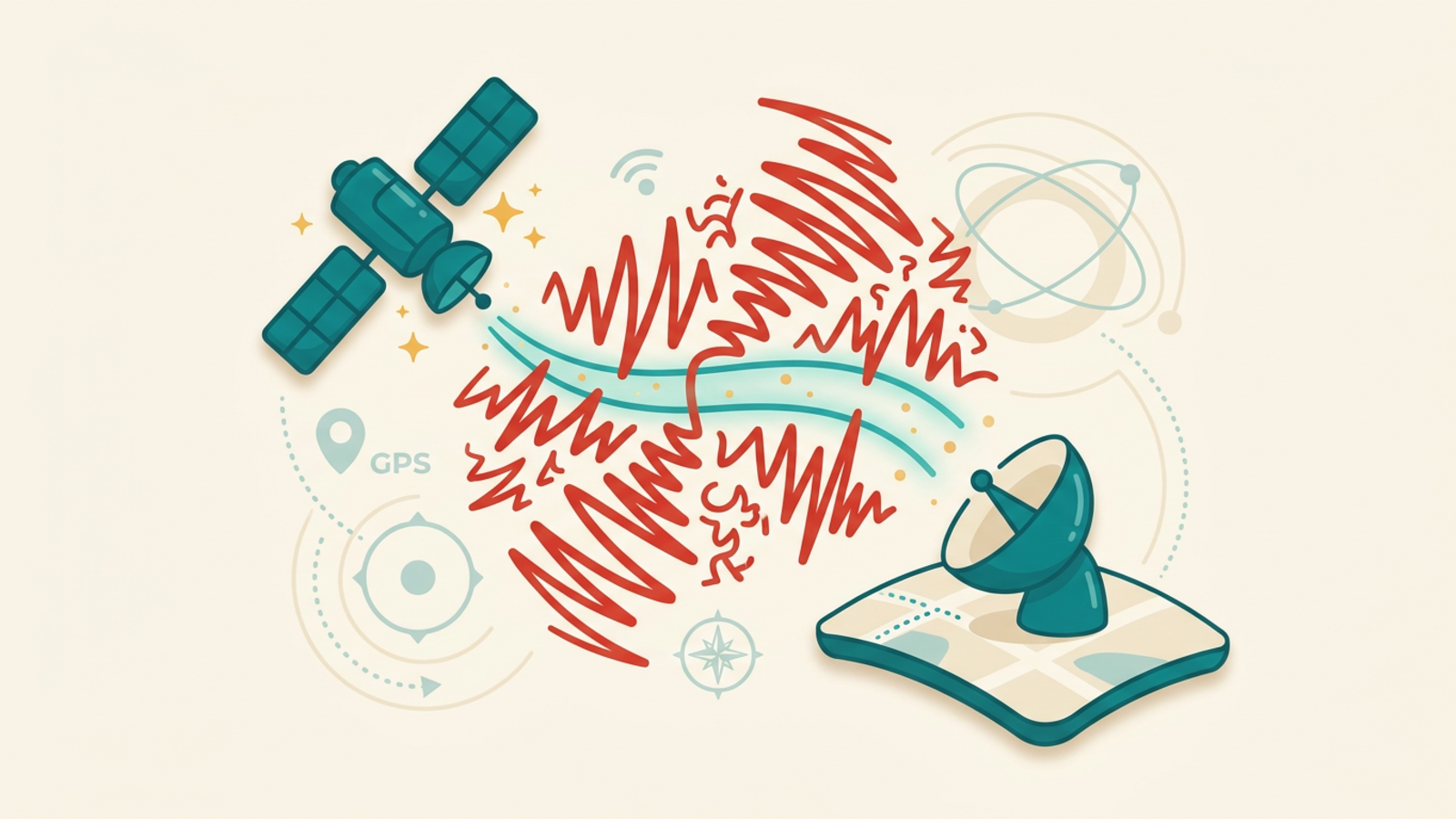
GPS is a marvel of trust. Satellites 20,000 km overhead broadcast signals so faint that they arrive below the background radio noise, and your receiver pulls order out of that whisper. The system is remarkably dependable: in the most recent published analysis, the GPS Standard Positioning Service met 100% of its coverage commitment with better than 99% availability. GPS jamming and spoofing exploit the one weakness that reliability cannot fix, which is how quiet the signal is by the time it reaches the ground.
Interference is not theoretical. In one enforcement action listed in the official explainer on GPS jamming, the FCC imposed a fine of USD 34,912,500 on a manufacturer that marketed 285 models of signal jamming devices to customers in the United States. Another case fined a driver whose jammer, meant to hide his own van from his employer, disrupted an aviation safety system beside Newark Airport.
That combination is the problem fleets and drivers face. The hardware is cheap and pocket-sized, the effect spills over onto everyone nearby, and the symptoms look exactly like an ordinary signal problem. A vehicle that vanishes from the map might be in a tunnel, or it might be in the back of a truck with a jammer running.
The Real Challenges of Trusting a Position
The first challenge is signal strength. A GPS signal reaches the antenna at roughly a millionth of a billionth of a watt, so a low-power transmitter on the same frequency drowns it across a surprising radius. Blocking the signal takes far less energy than sending it.
The second challenge is that a receiver has no built-in way to check whether a signal is genuine. Civil GPS signals carry no authentication, so a counterfeit that arrives slightly stronger than the real one gets believed. Your device is not fooled by a clever trick. It is doing exactly what it was designed to do.
The third challenge is diagnosis. Lost fixes, drifting positions and stale timestamps all have boring explanations most of the time: a parking garage, a dense city street, a failing antenna. Treating every outage as an attack wastes effort, and treating every attack as an outage loses a load.
How GPS Jamming Works
Jamming is brute force. A jammer transmits noise on the GPS frequency band, and any receiver close enough hears static instead of satellites. It cannot tell your device the wrong location because it does not send a location at all. It simply removes the option of knowing.
The devices are often sold as personal privacy protectors, marketed to drivers who want to disappear from a company tracking system. A unit the size of a cigarette lighter running from a 12 V socket knocks out reception for tens or hundreds of metres, which is why a single truck on a highway degrades reception for everything it passes.
Cargo thieves use the same tool differently. They jam both GPS and the cellular band so a trailer stops reporting, move it to a holding yard, and let the trail go cold. The signature is abrupt: a vehicle reporting normally, then nothing at all, at a time and place that makes no operational sense.
How GPS Spoofing Works
Spoofing is the sophisticated cousin. Rather than blocking the satellites, a spoofer broadcasts counterfeit signals that carry the correct structure but the wrong information. The receiver locks onto the stronger fake, calculates a position from it, and reports that position with total confidence.
A crude spoof teleports a target somewhere absurd, which is easy to spot. A careful spoof does the opposite: it matches the current position first, then walks the calculated location away by a few metres at a time so nothing on the screen looks alarming. The same technique shifts a receiver’s clock, which matters because power grids, financial systems and telecom networks all take their timing from GPS.
Spoofing takes more skill and equipment than jamming, so it is rarer in everyday theft. Where it appears is in high-value targets and in regions with sustained interference, where thousands of aircraft and ships have logged positions that were plainly wrong. The terms behind these signals are unpacked in our GPS glossary if you want the underlying vocabulary.
Warning Signs on a Live Map
Interference leaves fingerprints. Watch for these patterns before assuming a hardware fault:
- A clean disappearance. Several vehicles losing signal in the same stretch of road, at the same time, points at a source rather than a coincidence.
- Impossible movement. A jump of 40 km between two consecutive reports, or a speed no vehicle could reach, suggests a counterfeit position.
- Uniform satellite strength. Genuine satellites sit at different elevations and report different signal levels. A screen showing everything equally strong is suspicious.
- Clock drift. A device time that slides away from network time is a classic spoofing artifact, since the attack manipulates timing to move position.
- A stuck position. A vehicle frozen at one set of coordinates while the odometer keeps climbing means the fix stopped updating.
None of these signs is proof on its own. Two or three together, in the same window, is worth investigating as interference rather than a fault.
Why Jammers Are Illegal Almost Everywhere
Jamming is regulated so tightly because the harm never stays with the intended target. The same burst that hides one van from a dispatcher also blocks emergency calls, disables navigation for surrounding traffic, and reaches safety systems that were never part of the argument. Regulators treat it as a public-safety issue, not a privacy dispute.
United States law prohibits operating a jammer, and equally prohibits advertising, selling, importing or distributing one, with no exemption for a business, a home or a vehicle. Enforcement has produced fines running into eight figures. Broader guidance on spectrum interference explains how regulators police the neighbouring frequency bands that also threaten reception.
If you suspect deliberate interference, document the times and locations, rule out equipment faults with your provider, and file a report with the regulator rather than trying to locate the source yourself.
What Actually Protects Vehicles and Fleets
No single measure stops a determined attacker, so effective protection stacks several cheap ones together.
Use more than one constellation
A receiver that tracks Galileo, GLONASS and BeiDou alongside GPS has more signals to lose and more chances to notice disagreement. Dual-frequency receivers that listen on L1 and L5 raise the bar further, because an attacker has to counterfeit both bands convincingly.
Keep a backup that needs no satellites
Dead reckoning bridges the gap. Wheel-speed data, a gyroscope and an accelerometer let a vehicle estimate its own movement through a tunnel, a parking structure or a jamming event, then reconcile with satellites when the signal returns.
Alert on silence, not just on movement
The most valuable rule in a telematics platform is often the simplest: notify dispatch when a vehicle that should be reporting goes quiet for longer than a set number of minutes. Thieves rely on nobody noticing until the shift ends.
Check plausibility on the server
Software can reject what physics forbids. Flag reports that imply impossible speed, positions far from an assigned route, or a device clock that disagrees with the network. These checks cost nothing and catch most crude spoofing attempts.
Where the Defences Are Heading
The long-term fix is authentication. Newer signals let a receiver verify that a transmission genuinely came from the satellite that claims to have sent it, which turns spoofing from a technical exercise into a much harder cryptographic problem. Modernized civil signals and multi-constellation receivers are spreading through consumer hardware faster than most people expect.
Ground-based backups are returning too, alongside inertial systems accurate enough to carry a vehicle through long outages. Our look at the future of GPS traces how new satellites and signals change what a receiver can verify.
Make Your Fleet Harder to Fool This Quarter
Start with the settings you already own. Turn on loss-of-signal alerts, set a plausibility rule for impossible speed, and check whether your receivers track more than one constellation. Those three changes take an afternoon and catch the overwhelming majority of real incidents, which are opportunistic rather than expert.
If you want the underlying mechanics before you adjust anything, start with our plain-language explainer on how GPS works, which shows why the signal is so easy to drown out.
Frequently Asked Questions (FAQs)
Is using a GPS jammer illegal in the US?+
Yes. Operating a jammer that blocks or interferes with authorized radio communications violates federal law, with no exemption for use inside a business, a classroom, a home or a vehicle. It is also unlawful to advertise, sell, import or distribute one. Penalties include substantial fines, seizure of the equipment and criminal sanctions.
How can you tell if your GPS is being spoofed?+
Watch for a position that jumps somewhere implausible, a route that shows impossible speed between two points, or a device clock that suddenly drifts. Another clue is every visible satellite reporting an unusually strong and uniform signal, since genuine satellites vary. Receivers that track more than one constellation flag disagreement between them.
Can GPS trackers be jammed?+
They can. A tracker relies on the same faint satellite signal every receiver uses, so nearby interference stops it fixing a position. Many thieves also target the cellular side, which blocks the report rather than the fix. Good trackers respond by storing positions in memory and raising an interference alert instead of going quietly dark.
What protects fleet vehicles from GPS jamming?+
Layered defence works best: a multi-constellation receiver that also listens to Galileo and other systems, dead reckoning from wheel and inertial sensors to bridge outages, and telematics that alert dispatch the moment a vehicle stops reporting. Server-side plausibility checks catch positions that no real vehicle could produce.
Does GPS jamming affect phone navigation apps too?+
Yes. A jammer does not choose its victims, so every receiver in range loses its fix, including phones, dashcams and any nearby vehicle. That is precisely why the devices are banned. One driver’s jammer has interfered with aviation safety equipment near an airport, which shows how far the disruption reaches.