AirTag vs GPS Tracker: Which One Actually Finds Your Things
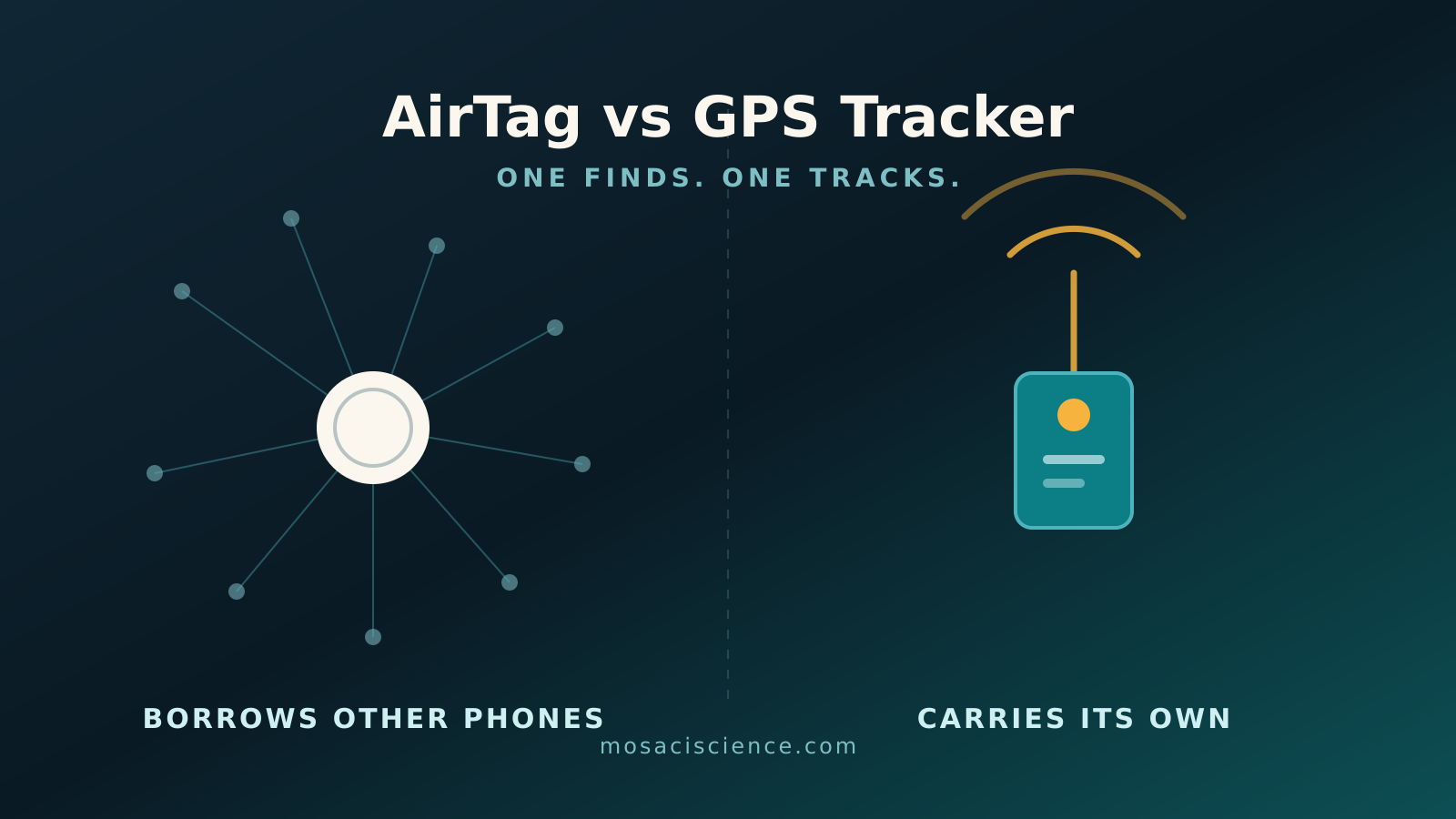
The AirTag question comes up on every tracking forum, usually phrased as whether a $30 tag can replace a device with a monthly bill. The honest answer is that they are not competing products. One is a finder and one is a tracker, and the words describe genuinely different machines.
It matters commercially because the gap is where most of the disappointment in this category lives: the GPS tracking device market is set to rise from USD 4.52 billion in 2026 to USD 14.98 billion by 2033, and a large slice of first-time buyers start with a Bluetooth tag and then replace it.
The confusion is understandable. Both show a location on a map in an app. The difference is in how that location got there, and it only becomes visible on the day something goes missing somewhere quiet.
Two Completely Different Machines
An AirTag has no GPS receiver and no cellular radio. It broadcasts an encrypted Bluetooth identifier and waits. Any nearby Apple device that hears it reports the position to iCloud on its behalf, anonymously. Close up, a second-generation ultra-wideband chip drives Precision Finding and walks you to it. It runs on a user-replaceable CR2032 rated at more than a year and is IP67 rated to one metre for thirty minutes. It needs no subscription because it has nothing to pay for.
A cellular tracker like the Mobile-200 does the opposite. It calculates its own position from satellites, then pays a mobile network to send that position to you on a schedule you choose, as often as every 30 seconds. That is why it costs $12.50 a month on an annual plan and why it works in an empty field.
So the real question is never which is better. It is whether the thing you are protecting will be somewhere with other people’s phones in it.
| Question | Apple AirTag | Cellular GPS tracker |
|---|---|---|
| How it reports | Borrows nearby Apple devices | Its own cellular connection |
| Works in an empty area | No | Yes, with cell coverage |
| Update control | None, reports opportunistically | From 30 seconds, by plan |
| Running cost | None | From about $8 to $23 a month |
| Battery | Over a year, replaceable CR2032 | Days to years, by report rate |
| Warns a stranger it is present | Yes, by design | No |
| Best at | Luggage, keys, bags, city use | Vehicles, equipment, shipments |
Where Each One Quietly Fails
The AirTag fails by going stale rather than by going wrong. The app keeps showing a position, the position is simply old, and nothing tells you how old it is in a way that reads as an alarm. That is the failure mode that catches people out with a stolen vehicle: the map looks fine and it is describing a place the car left four hours ago. The anti-stalking feature compounds it, because a thief carrying an unknown tag gets a notification telling them to look for it.
Cellular trackers fail more honestly and more expensively. They stop reporting entirely inside a steel container, a basement car park or a rural coverage gap, which at least looks like a fault rather than a fact. They also run out of battery, on a schedule set by how often you asked them to report, and the cheap plan tier that sounded fine is frequently reporting too slowly to follow anything moving. Neither device solves the problem of being switched off, removed or thrown out of a window.
When the Tag Is Genuinely the Right Answer
Luggage is the clearest case. Airports and aircraft are among the densest concentrations of Apple devices anywhere, so a tag updates constantly, costs nothing to run, and survives a year on a coin cell. The same holds for keys, wallets, laptop bags and anything that gets lost in populated places.
Small businesses have found a second use that works: tools and cases that live in a van and move between crewed sites. There are enough phones around a working crew for a tag to stay current, and at tag prices you can put one on everything rather than choosing which items deserve a subscription.
When You Need the Radio
Anything that can end up somewhere deliberately quiet needs its own connection. Stolen vehicles get parked where nobody goes. Trailers sit in yards overnight. Shipments cross regions where nobody is carrying the right phone. In those cases the tag has no network to borrow and the tracker is not optional.
At business scale there is a third pattern that borrows the best of both: cheap Bluetooth tags on everything, reporting through a smaller number of cellular devices or gateways that carry the connection for them. That is how asset tracking platforms cover hundreds of unpowered items without buying hundreds of subscriptions, and it is the same principle as the Find My network with infrastructure you control instead of strangers.
Deciding by Where the Item Goes
Forget the price comparison and answer one question: when this goes missing, will it be somewhere busy or somewhere quiet? Busy means a tag will find it and you should not pay a subscription. Quiet means only a device with its own connection will report, and the monthly fee is the price of that.
If the honest answer is both, buy both. They are cheap enough to layer, and they fail in different places, which is precisely why layering works. Put a tag in the bag and a cellular tracker on the vehicle carrying it.
For a closer look at what the cellular option costs once the subscription is counted, see our breakdown of what “no monthly fee” really buys you.
Frequently Asked Questions (FAQs)
Can an AirTag track a stolen car?+
Sometimes, and unreliably. It reports only when a passing Apple device hears it, so a car left on a busy street may update often while one parked in a rural yard or a closed garage goes silent for hours. It is also designed to warn a stranger that an unknown tag is travelling with them, which is good for privacy and bad for recovery.
Do AirTags work without other iPhones nearby?+
No. That is the whole design. An AirTag has no cellular radio and no GPS receiver of its own. It broadcasts an encrypted identifier over Bluetooth and relies on the Find My network of Apple devices to relay a position, so in an area with no Apple devices it cannot report anything.
Is a GPS tracker better than an AirTag for luggage?+
For most travellers, no. Airports and aircraft are dense with Apple devices, which is the one environment where a Bluetooth tag performs close to its best, and it needs no subscription. A cellular tracker is the better choice only if your bags routinely end up somewhere quiet.
What does a GPS tracker do that an AirTag cannot?+
It reports on its own schedule rather than waiting to be overheard, it works in empty places, it can update every few seconds instead of whenever someone walks past, and it supports geofence alerts that fire the moment something moves. It costs a monthly fee because it is paying a mobile network to do all of that.