Bluetooth Tracker vs GPS Tracker: What Separates a $29 Tag From a $29 a Month Device

Two products share the word tracker and almost nothing else. One is a coin-sized tag with no GPS receiver and no SIM, sold once for about $29. The other is a device that fixes its own position from satellites and pays a mobile network to send it, sold for $29 up front and again every month. The US government publishes GPS accuracy specifications for the signal itself, and neither product argues with them, because only one of the two is using GPS at all.
The confusion is expensive in one direction only. Nobody buys a cellular tracker for their keys and regrets it much. People do buy Bluetooth tags for trailers, tool chests and vans, and then discover the location is three days old. Apple is clear in its own specification about what is inside: Bluetooth, an Ultra Wideband chip and NFC. No GPS. No cellular.
What makes this hard to see before you buy is that both products show a pin on a map in an app. The interface hides the mechanism completely, so the difference only appears on the day you need it: the tag stops updating in the exact conditions where a valuable thing goes missing.
| Feature | Bluetooth tag | Cellular GPS tracker |
|---|---|---|
| Radios on board | Bluetooth, UWB, NFC | GNSS receiver, 4G or 5G modem |
| Who calculates the position | A passing stranger’s phone | The device itself |
| Works with nobody nearby | No | Yes |
| Update timing | Whenever someone walks past | A schedule you set |
| Typical price | $29 each, $99 for four | $28.99 to $64.99 plus $9.95 to $49.95 a month |
| Battery | Over a year on a CR2032 | Days to years, set by update rate |
| Geofence alerts | No | Yes |
AirTag figures from Apple’s own product page, tracker figures from vendor pages, all fetched 18 September 2026.
Where the Two Products Actually Diverge
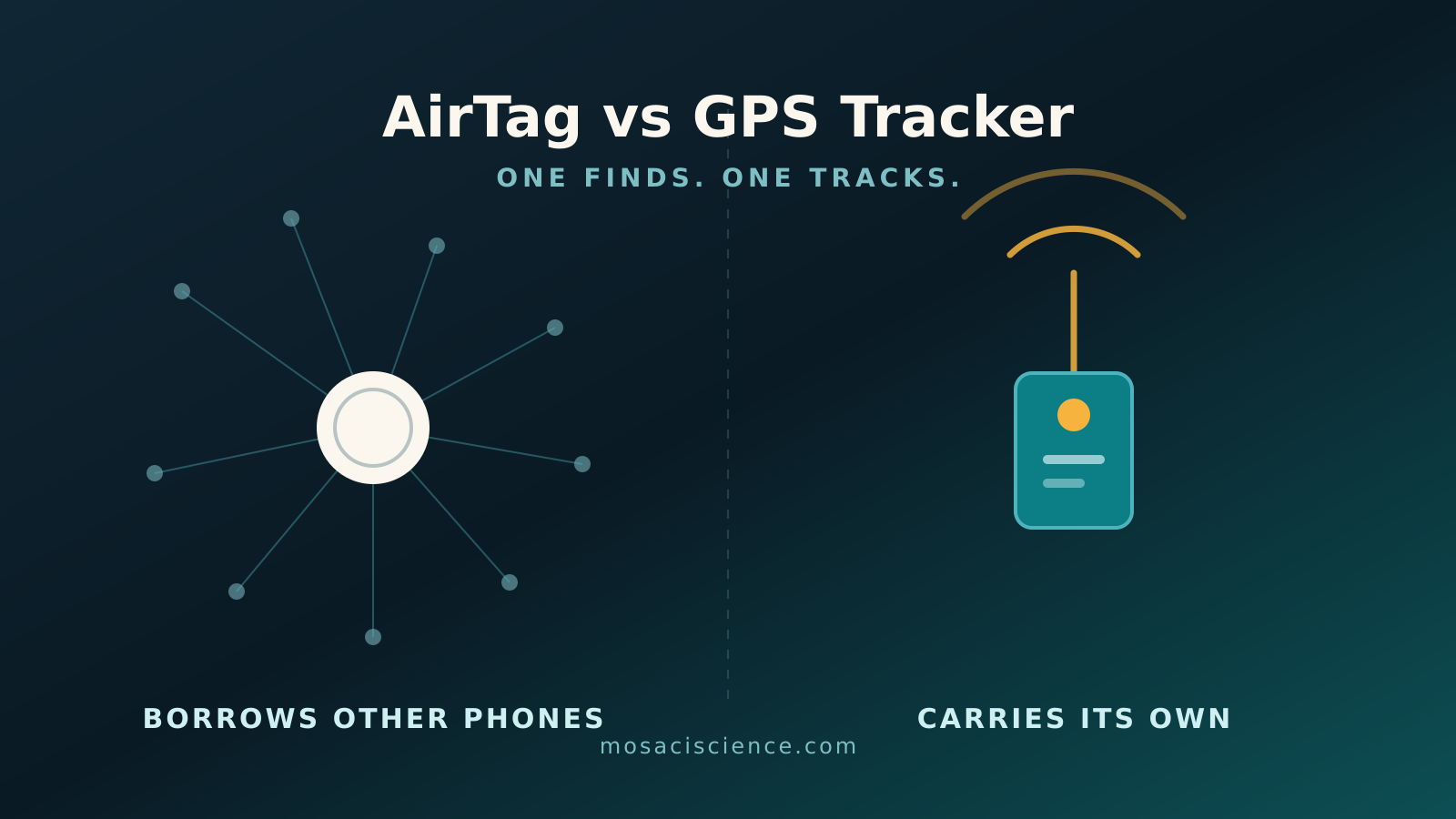
The whole difference reduces to one question: who works out where the thing is. A GPS tracker does it itself, using the same satellite signals a car navigation system uses, then pays a cellular network a few dollars a month to carry the answer to you.
A Bluetooth tag cannot do either half. It has no receiver to calculate a position and no modem to send one. What it has is a radio that shouts a short encrypted identifier a few times a second, and a bet that somebody carrying a compatible phone will hear it.
That bet is very good in a city and very bad in a yard. It is not a question of signal strength or a better antenna. In a fenced compound at 2am there is no phone to hear the shout, so there is no position to report, and the map keeps showing you the last place a human happened to be.
What the Networks Are and Are Not
Apple states the Find My network reaches more than a billion devices, and that the relaying is anonymous and encrypted so not even Apple knows the location of your tag. Both of those things are true and neither changes the geography problem. A billion devices distributed where people live is still zero devices where your excavator is parked.
Some business-grade Bluetooth tags address this differently: instead of relying on consumer phones, they pair with a cellular device you already own, which acts as the reader for everything clustered around it. That works because you control where the reader is. It also means the tags only report when the reader is in range, which is a deliberate trade rather than a hidden one.
Cost Over Three Years, Which Is Where It Bites
Four AirTags cost $99 once. Four cellular trackers on a mid-tier plan cost roughly $1,500 over three years. If the four things you are tracking are a laptop bag, a set of keys, a suitcase and a bike that lives in a shared hallway, the tags win by an enormous margin and there is nothing clever to say about it.
Flip the assets and the arithmetic flips with them. One stolen trailer, one generator, one skid steer, and the three-year subscription is cheaper than the excess on the insurance claim. The published price of a multi-year asset tracker sits around $54.99 with a $12.50 monthly plan, which is the real comparison point for anything that leaves a populated area.
The Safety Feature That Is Also a Business Problem
Bluetooth tags are designed to be found by people who did not buy them. Apple states that an unknown tag travelling with you triggers an alert on iPhone and on Android, and that the tag itself starts playing a sound if it stays separated from its owner. That is the correct design for a consumer product and it has real safety value.
It also makes tags unsuitable for anything a business needs to be discreet about. A tag placed in a company vehicle will announce itself to whoever is driving, which for a service van is at best confusing and at worst a personnel dispute. Cellular trackers do not broadcast to nearby phones, so they raise a different set of legal questions rather than this one.
Match the Radio to Where the Thing Goes
Write down where the item spends its nights. If the answer is a home, an office, an airport or a train, a Bluetooth tag will find it and you will never pay a subscription. If the answer is a yard, a field, a depot, a container or the back of a truck on an interstate, only a device with its own receiver and its own modem will still be reporting at 3am.
Everything else, size, price, battery, app quality, is secondary to that one question, and it is the question almost nobody asks before checkout. If you want the longer version of the technology split, our comparison of GPS against BLE and RFID covers where each one earns its place, and the AirTag head-to-head goes deeper on the consumer side.
Frequently Asked Questions (FAQs)
Does an AirTag have GPS in it?+
No. Apple lists exactly three connectivity items for AirTag: Bluetooth for proximity finding, an Apple-designed second-generation Ultra Wideband chip for Precision Finding, and NFC tap for Lost Mode. There is no GPS receiver and no cellular radio in the device. Every position you see came from somebody else's iPhone, iPad or Mac detecting the tag and reporting it to iCloud.
So how does a Bluetooth tag show a location on a map?+
It borrows one. The tag broadcasts a secure Bluetooth signal, any nearby device on the network hears it, and that device sends its own location to the cloud. Apple describes the Find My network as reaching more than a billion iPhone, iPad and Mac devices. The accuracy you get is the accuracy of the phone that walked past, and the freshness is whenever that happened to be.
When is a Bluetooth tag genuinely the right answer?+
When the thing you are finding stays where people are. Keys, a wallet, a laptop bag, luggage moving through airports, a backpack in a school. Dense footfall is what makes the network work, and at $29 for one or $99 for four there is no subscription to cancel. For those jobs it beats a GPS tracker on cost and on size.
What does a GPS tracker do that a tag cannot?+
Report from an empty place. A cellular GPS tracker calculates its own position from satellites and sends it over a mobile network, so a trailer in a rural yard at 3am reports exactly the same as one in a city centre. It also updates on a schedule you choose rather than when a stranger happens to pass, which is what makes geofence alerts and theft recovery possible.
Can I use Bluetooth tags on company vehicles or equipment?+
You can attach them, but they will not behave like fleet trackers. A vehicle parked overnight in a fenced industrial yard has nobody walking past it, so the last known position can be hours or days old. Bluetooth tags also fire unwanted-tracking alerts on both iPhone and Android when they travel with someone who does not own them, which is the opposite of what a business wants on a service van.