UWB vs Bluetooth vs GPS: Three Radios That Answer Three Different Questions

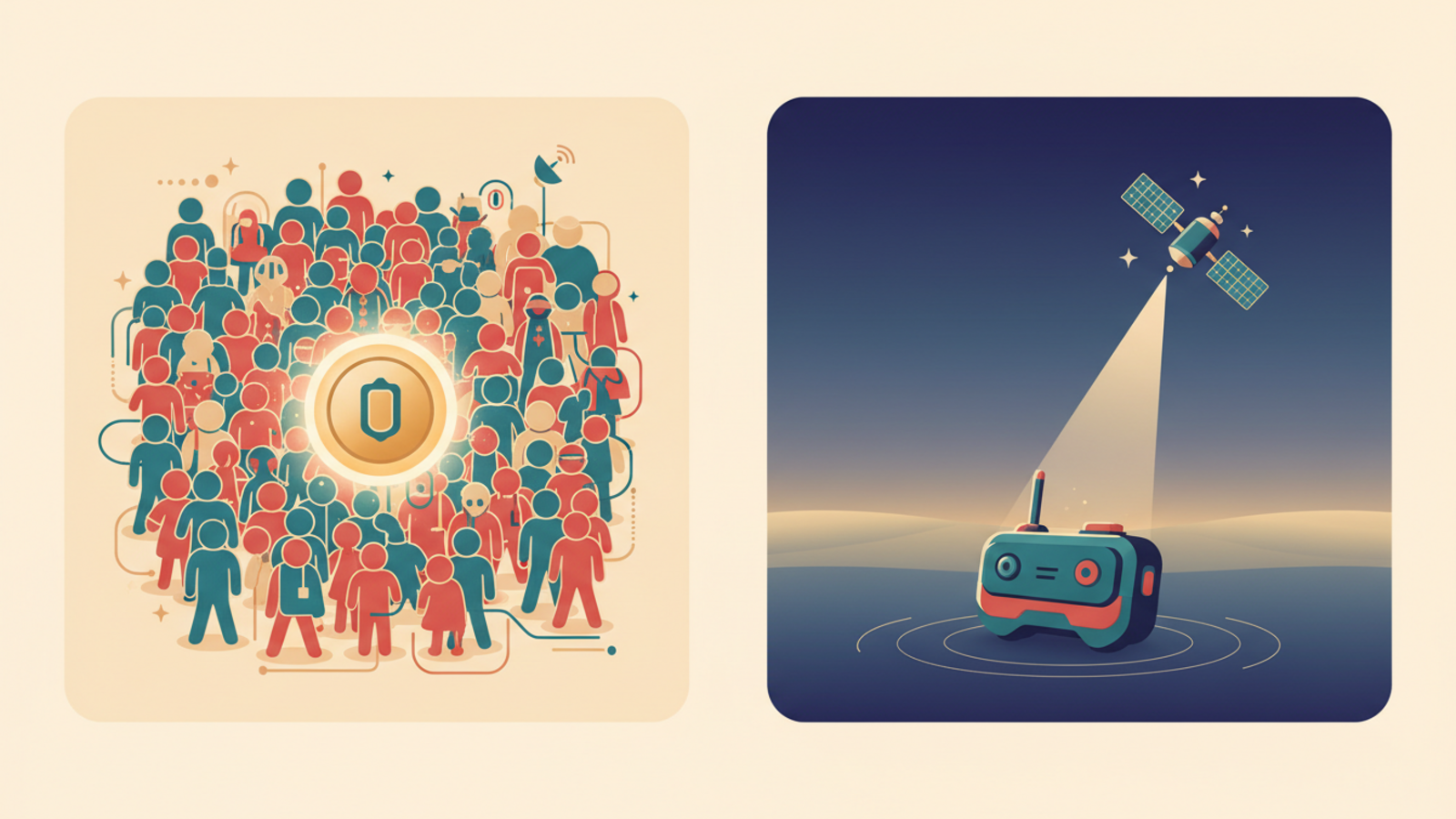
Three radios get compared as though one of them wins. They are answering different questions. Ultra Wideband answers where in this room, Bluetooth answers where in this building or which passer-by saw it, and GPS answers where on Earth. The US government publishes the accuracy specification for the GPS signal itself, and none of the other two is trying to compete with it.
The reason this matters commercially is that products built on each radio look similar in an app and cost wildly different amounts to run. A tag with no cellular connection costs nothing per month forever. A device that fixes its own position pays a mobile network every month for the privilege.
Buyers rarely go wrong on accuracy. They go wrong on what has to be nearby for the thing to work at all, which is the specification nobody prints on the box.
| Property | Ultra Wideband | Bluetooth LE | GPS and GNSS |
|---|---|---|---|
| Answers | Which direction, how far | Is it near something | Where on Earth |
| Working range | Metres | Tens to low hundreds of feet | Global |
| Needs nearby | A compatible phone in hand | A phone or gateway | Sky, plus a modem to report |
| Works indoors | Yes | Yes | No |
| Works with nobody around | No | Only with your own gateway | Yes |
| Running cost | None | None, or gateway cost | Monthly cellular plan |
| Battery drain | Low, used in bursts | Very low | High per fix |
Ultra Wideband: The Last Ten Metres
UWB works by timing a radio pulse rather than measuring how loud a signal is, which is why it can state a distance and a direction instead of a vague nearer or further. That makes it excellent at the final stage of a search, when you already know roughly where the thing is and need to find it behind a cushion.
Apple lists a second-generation Ultra Wideband chip in AirTag for exactly this, with expanded Precision Finding on iPhone Air or iPhone 15 and later, excluding the 16e and 17e. It quotes up to 1.5 times the range of the previous generation rather than an absolute figure.
What UWB cannot do is tell you anything when you are not standing near the item. It is a finding aid, not a tracking technology, and treating it as the latter is the most common misreading of the spec sheet.
Bluetooth LE: Cheap, Patient, and Dependent
A Bluetooth tag broadcasts a short encrypted identifier and waits. Something with a data connection has to hear it, which is either a stranger’s phone on a consumer network or a gateway you control.
The economics are unbeatable when it works. No SIM, no data plan, and battery figures measured in years: GPX quotes up to four years from a CR2032 in a 6mm tag reading at about 150 feet outdoors and 75 feet indoors. Nothing with a cellular modem gets near that.
The dependency is the whole risk. In a busy building, coverage is excellent. In a fenced yard at 3am, there is nothing listening, and the tag is broadcasting perfectly to an empty field.
GPS: The Only One That Works Alone
A GNSS receiver calculates its own position from satellite timing, which means it needs no infrastructure, no phones and no gateways. It also needs a clear view of the sky, so it fails indoors and inside steel, and it needs a second radio to tell anyone the answer.
That second radio is the cost. A cellular modem and a data plan are why GPS trackers carry monthly fees and Bluetooth tags do not, and why a GPS fix is expensive in battery terms while a Bluetooth broadcast is nearly free.
It is the only one of the three that works in an empty place, which is why every serious asset deployment ends up with at least one GPS device even when most of the items carry tags.
Why Real Devices Carry Two or Three
The interesting hardware stopped choosing. A modern asset tracker commonly carries a GNSS receiver for outdoors, WiFi positioning as an indoor fallback, a cellular modem to report, and a Bluetooth radio so it can read tags on smaller items nearby.
That last radio is the commercially significant one. It turns a single subscription into coverage for a cluster: the machine reports itself and reports the twenty tagged things sitting around it. The trade is that the tags are only visible while the reader is there.
WiFi positioning is the fourth radio that quietly does a lot of work. It estimates position from the WiFi networks a device can see, without joining any of them, which gives a usable indoor fix in places a satellite cannot reach. It is less accurate than GPS outdoors and far cheaper than installing beacons indoors, which makes it the pragmatic middle option on devices that move between both.
Ask What Has to Be Nearby
Before comparing accuracy figures, answer one question for the thing you want to find: what will be within a hundred feet of it at three in the morning. If the answer is people, a Bluetooth tag is cheap and sufficient. If the answer is your own equipment, a tag plus a reader works. If the answer is nothing, only a device with its own receiver and its own modem will still be reporting.
That question sorts this entire category faster than any spec comparison, and it is the one buyers skip. Our breakdown of GPS against BLE and RFID adds the RFID case, and Bluetooth tags against GPS trackers covers the consumer side in detail.
Frequently Asked Questions (FAQs)
What is Ultra Wideband actually for?+
Precision at close range. UWB measures the time a radio pulse takes to travel, so it can give direction and distance to something a few metres away rather than just telling you it is somewhere nearby. Apple uses it for Precision Finding on AirTag, working with iPhone Air or iPhone 15 and later, and quotes up to 1.5 times the range of the previous generation tag.
Is UWB more accurate than GPS?+
At short range, by a wide margin, and it is irrelevant at any other range. UWB resolves position to roughly the width of a hand in the same room. GPS resolves to a few metres anywhere on Earth. They are not competing measurements: one tells you which shelf, the other tells you which city.
Why do Bluetooth tags need other people's phones?+
Because Bluetooth LE is a short-range radio with no way to reach the internet by itself. The tag can shout an identifier a few tens of metres, and something with a data connection has to hear that shout and relay it. Apple's network reaches more than a billion Apple devices, which works where people are and does nothing where they are not.
Which one works in a warehouse?+
Not GPS, because a roof blocks the satellite signal. Indoor positioning is normally Bluetooth beacons read by fixed gateways, sometimes with UWB where centimetre accuracy is genuinely needed, and increasingly WiFi positioning as a cheap approximation. Outdoor yards are the reverse: GPS works and beacon infrastructure is expensive to spread over acres.
Can one device use all three?+
Several do. A cellular asset tracker commonly carries a GNSS receiver for outdoor position, WiFi positioning for indoors, and a Bluetooth radio so it can read tags attached to smaller items around it. That combination is what lets one subscription cover a machine plus the twenty things that travel with it.